
An Ode to Editing
–why consciously cutting and prioritizing is a key writing as well as life skill

Some writers hate to be edited and others love it. Some writers hate to self-edit as well, while yet others understand that it is where the real work of creating (crystal clear) meaning actually begins.
Living with a strong Type 5 secondary fix means that I personally love both. Although these days my written work isn’t edited by others anywhere (i.e. in my paid ‘work work’ or my hobby blogging here on Substack), but I have been lucky enough over the years to have had amazing editors who I learned a lot from in different writing contexts. They generously guided my writing –and thinking– with their objective and skilled comments.
Over the years I’ve also been living quite a ‘criteria- and checklist-minded’ life because I’m all for minimalism, having high standards, and conscious living, which all require a constant, intentional editing of one’s life experiences such jobs, relationships, personal habits, etc., with the understanding that what you expose yourself to will form you in significant (and often invisible) ways.
In true T5 fashion I too have been doing the constant hard work of trying to understand, keep up with (and better yet, lead too, where possible); and at the bare, bare minimum, at least always make sure I safely orient to ‘reality’.
· Living in three languages is all about constant ‘encoding-decoding’ –and lots of gibberish note taking, messy trilingual grocery lists, and speaking to the dog in Spanglish-Hungarian (although he really only focuses on tone, of course, and even largely ignores that :D); as well as talking to friends or my mom in the wrong language accidentally, etc.
· Moving, dating, working cross-culturally also requires constant ‘cultural editing’ of myself –knowing what’s frowned upon in one culture but is outright expected in another, and knowing when to switch swiftly and how (so that you don’t ‘frighten’ others by how ‘different’ you are)
· Social contexts editing (e.g. having poor friends, rich friends, friends with small kids, friends with no kids, friends with grown kids –and anything in between, etc.)
· Having worked in ESL (or ELT, aka English language teaching) for two plus decades has meant using the CEFR (Common European Framework Reference) to check people’s level of English day in, day out, in multiple ways (e.g. when teaching, teacher training, materials writing or assessing)
· Wearing my Enneagram lens ‘IRL’ (in ‘real’ life), trying to always quickly assess ‘who’s talking’ in any interaction or new relationship, to know where this person is coming from –i.e. what their Type, Dominant Instinct and levels of self-awareness (emotional and spiritual health) might be, and adjust course accordingly
· While also trying to be mindful of my own ‘conscious self-regulation’ (or self-’editing’) –see more on this later in this post.
· ...and yes, in writing too –by creating editing checklists, and borrowing others’ as well.
I do all this because I want to know. I want to GROW.
And although I’m a Body Type (so generally fussy about who wants to ‘impact me’, f with my boundaries or agency, etc.), I do welcome, even want good quality, ‘high octane’ input on any new skill I’m developing. When it comes to improving my writing now, I do this by
a, reading (exposing myself to) good stuff,
b, reading (exposing myself to limited amounts of) bad stuff (while consciously identifying all the ways they suck), and
c, reading the behind the scenes, the techniques and generous unveils of practitioners who have proven authority (in my eyes).
Criteria, editing and checklists are Type 5s’ (and everybody’s?) guardrails and ‘conscious scaffolds’ to the new. They are the path to fluency-through-accuracy in any new skill you’re developing (aka a more precise, slower, bottom-up way of acquiring skill, and a more sustainable one in that you learn things well the first time, therefore no ‘unlearning and relearning’ will be necessary later on.)
In other words, checklists help you to
“Learn the rules like a pro, so you can break them like an artist.” (Pablo Picasso, Type 8)
You cannot do it the way round (only the dilettante do); you have to earn your right to skillful freestyle in your field first (otherwise known as mastery).
Allegedly, some (very few) successful authors don’t edit at all, and are awesome at their art anyways, but I think the majority who write, also edit a lot ... and then we still suck (at times).
Because sucking is a feature, not a bug. It is part of the deal, it is inevitable. It is through said suckin’ that we make contact with reality, through doing –as opposed to just theorizing. (#T5)
If you’ve also ever had plumbing problems in your home you know that when the pipes have been fixed and you open the tap again, first you’ll have to let the muddy, rusty water out (with the occasional bursts of some clear water mixed in too), until it’s mostly all clear again.
It is the same with writing, and not just when you restart, but when you start at all. Good editing just prevents you from splashing your reader with (too much) of your sh*tty water in the face.
(How is that for an image. A tad much, innit. Maybe it should be edited out...? Oh, well. I don’t have an editor to help me decide on this for now, unfortunately, and like most, I also sometimes struggle mightily to ‘murder my darlings’ ... (Stephen King)
Editing my stuff, saying goodbye to clunky bits I just sweated my way through recently is hard even for me being a triple #Rejection Type, which means that objectivity, detachment, and having a ‘cold eye’ when it comes to cutting my own stuff can come (too eerily) easily to me sometimes.
And even though I largely agree that
“To write is human, to edit is divine.” –Stephen King–
I also realize that stream of consciousness kind of writing is also important, maybe almost more important, especially starting out (=either as a new writer and/or changing genres and/or at the earlier stages of conceptualizing a new piece of work). You need abundance first, then you cut. (Otherwise you’re just overediting a bit fat lot of nothing.)
I have an idea (bias, assumption ...) as to which Enneagram Types (and Instincts) might make the best editors (5s and 1s, as well as SP Doms?), but we all have to make do with what our personality will allow for –especially until we get the luxury of pros (also) editing our work.
My process now is
T8: instant (top down) holistic ‘gut knowing’ of what works and what doesn’t,
followed by
T5: secondary (bottom up) conscious, cognitive ‘double checking’
I’m aware that in a way all this is still very ‘vertical’ ... –and that there’s lots of richness of hue that I might be missing out on on the ‘horizontal’ levels –that my personality just doesn’t naturally like to focus on by default ... but first things first, I guess.
This is not trying to be an excuse for not making an effort to grow, but more an acknowledgement, that at times
we best serve our talents by doubling down on what we’re already best at (i.e. from #essence),
while ignoring diligently ‘ironing out’ the things where we are (can only be) mediocre at best.
I DO want to learn to filter both my writing and my personality better, however, (without trying to become somebody else anyways), so that I can avoid accidentally splashing others around me in the face with ‘stuff’.
In an attempt to learn more about conscious editing, last week I read Stein on Writing by Sol Stein, and decided to pick this book for today’s article too.
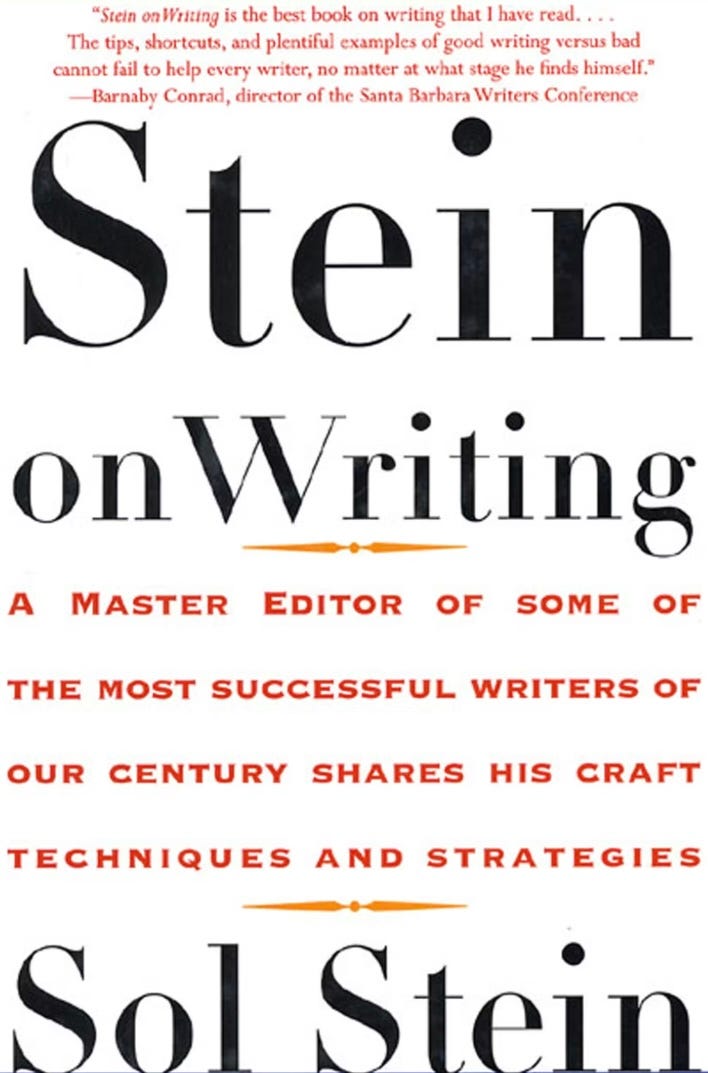
According to our overlords, Sol Stein (1926–2019) was a prolific author, editor, and publisher, whose bibliography is split between his work as a novelist and award-winning playwright, as well as his widely respected guides on the craft of writing. (Oh, and he also edited such legends as James Baldwin and George Orwell, so the guy must have known his shit.)
Not sure about his Type, so I probably shouldn’t hypothesize much here (and he’s dead too, with very little footage of him on YouTube), but reading him he sure feels SP 1 to me, based on the following 9 traits of his work:
· lots on systematic ‘perfecting’
· ... and being ‘frustrated’ by what’s NOT
· a direct, ‘no-nonsense‘ editorial approach
· treating writing as a craft that can be mastered through specific, repeatable techniques rather than just ‘waiting for the muse’
· famously demanding
· high standards for what constitutes “good” literature –to the writers he edited, and to his own writing
· obsession with “clutter” and the idea that the secret to good writing is actually good rewriting (and heavy cutting)
· editing a ‘systematic way to heighten the reader’s emotional experience’ (SP 1 integrating SX and T4 ...?)
· his philosophy centered on the idea that the writer’s job is to provide an experience superior (=’better’) to everyday life
My favorite 9 key takeaways from his editing principles and techniques are as follows.
1, It Takes Guts to Be a Writer
In Chapter 27 (titled ‘Guts: The Decisive Ingredient’) he talks about how being willing to reveal all is indispensable (’the willingness to broach the unspeakable’).
· “ ... the single characteristic that most makes a difference in the success of an article or non-fiction book is the author’s courage in revealing normally unspoken things about himself or his society”.
· “... the writer’s job is to tell the truth in an interesting way”
He also adds that
· the non-fiction writer is probably ‘more exposed’ than a fiction writer, because they don’t even have plausible deniability like fiction authors.
Now granted, mad honesty just for honesty’s sake, without technical skill (’craft’) or any meaningful structure is probably just cheap sensationalism. But IF the piece you’re writing requires that you ‘open a vein and bleed’, as he says in the book, you MUST be willing to go there.
Which is why SX doms and ‘expressive’ or ‘truth telling’ types such as T4, 6 and 8 can be good writers if they get their technical reps in too –”the best authors are those who are most outspoken” ....
We might drag our feet to strip this drastically because there is a lot at stake, of course: one’s reputation as a ‘sane, functioning, safe member of society’ (which none of us are, in my opinion, at least not to the 100% that we sometimes like to pretend), our allegiance to our profession, a field, a family, a church, etc.
(Side not on this last point: I will soon write about just this exact core memoir writing dilemma in an upcoming review of my current best favorite book ever of any genre, Tara Westover’s Educated. It takes extra guts for a SO 5 (SO/SP 5w4) –which I think she might be– to choose to become this visible, and then pay the inevitable social costs too.)
2, We’re All Given Different Scripts in Life
Chapter 7 (’The Actors Studio Method for Developing Drama in Plots’) is all about the Enneagram, albeit implicitly. In it he describes how we’re all given different scripts in life, and how, by giving each character a different ‘version of reality’ we can create great drama.
He describes how he likes to teach this to writers by giving one workshop participant the (secret) perspective of e.g. that of a high school principal who just expelled a hopelessly problematic teenager from the school, and to another the role of the mother of a ‘bright, well-behaved boy, a first-class student that ‘the principal is prejudiced against’. Boom, now we have a situation.
The same is true in life, where we’re also watching very different parallel ‘movies’ (our personality ‘realities’). And because the Enneagram provides the key to these ‘secret’ different perspectives, it is also a great tool for writers of various genres too, who want to develop lifelike characters (=consistent, properly fleshed out in terms of core motivations).
Stein also teaches writers to improve their ‘cartoonish’ antagonists as well, who, in his opinion, shouldn’t be too one-dimensional, nor ‘evil for the sake of it’, but rather have ‘rational motivations’ and believe that they’re ‘the hero of their own story’. (Or in other words, human with a #personality and all the distortions that come with it.)
3, How to ‘Show Don’t Tell’
I loved his short core distinction between fiction and nonfiction at the very beginning of the book where he says that
“Nonfiction conveys information. Fiction evokes emotion.” –Sol Stein–
It really helped me continue preparing for writing my favorite genre one day, a memoir, which I think is somewhere in-between.
He says that
“The writer’s job is not to provide a report of what happened, but to provide a lived experience.” –Sol Stein–
He also deals at length with the advice of show-don’t-tell, and how writers struggle to learn what this actually means in practice.
To teach writers actual story telling as opposed to mere ‘reporting’, he recommends paying attention to not telling
–what happened before the story began
–what a character looks like
–what a character senses (sees, hears, smells, touches and tastes)
as this always means that the author’s voice will ‘intrude on the reader’s experience’.
Instead, we should show things through actions and clever (but lifelike) dialogue –for instance instead of *’Henry, your son the doctor is at the door’ better e.g. ‘Do you think Henry would look more like a doctor if he grew a beard?’ and *’He was nervous’ vs ‘He tapped his fingers on the tabletop’
What matters is that the reader should be a witness to the story, not the recipient of a report of it.
A good way to ‘operationalize’ this advice is to check if a scene is ‘visible’/filmable. If it isn’t, you’re telling, not showing, and by doing so depriving the reader of their experience.
4, Love Scenes
I (of course) loved his tips on writing love scenes (in Chapter 18), including how
· we should “focus on the anticipation and the senses, not the mechanics because ‘the tension is in the before.’
· the reader needs to understand the relationship between the lovers better than either of the lovers do
· love scenes have to have two key ingredients: tension and tenderness
· we should practice writing ‘ten-line-dialogues’ where we show that the characters are in love and are quarreling at the same time
· the main themes to consider tapping into if you want to spice up your love scenes or plot: the competition, passing age boundaries and other taboos, aging and losing your sex appeal
“Sex has to be good for both partners. That is also the key to writing both fiction and non-fiction. It has to be a good experience for both partners, the writer and the reader, and it is a source of distress for me to observe how frequently writers ignore the pleasure of their partners. The pleasure of writer and reader are interwoven.” (Chapter 1)
5, Minimalism
I love what he teaches about writing ‘lean’, and theoretically (...) I agree that
· if you use two adjectives or two metaphors to describe the same thing, you diminish the power of each; you need to cut the weaker one because ‘one plus one equals half’
· cut any ‘flab’ such as adverbs (e.g. very, really, suddenly, and almost) and use a stronger verb instead (e.g. ‘sprinted’ for ‘ran quickly’)
· protect ‘the reader’s trance’ at any cost by clearing up any clunkiness that breaks the spell and reminds the reader they are reading a book
In practice I love me adverbs though, and just in general saying the same thing sometimes not with two but 4-5 words and synonyms, ‘just to make sure’ (I overkill real good). #lust, you see, I’m working on it, as #personality affects my writing as well, of course.
6, Action and Pace
Another sign Stein might have been a Body Type (and #frustration at that, aka T1) is his bias for action and ‘all things in medias res’, as well as using snags and obstructing your characters. Some of his more famous ideas re action and pace include that
· a story should start ‘at the moment things change’
· cut any intros where your character is waking up, eating breakfast, and start where the conflict begins
· similarly, cut any ‘bridging scenes‘, i.e. places where characters are driving to a location, waking up, or entering a building (’jump-cutting’ between scenes like this is ‘amphetamines for prose’)
· be a ‘troublemaker’: thwart desire to engineer plot
· ‘plot is simply the record of a character’s desire being constantly frustrated’
· a scene only starts when a character wants something, and it should only end when they have either failed to get it or gotten it only to realize it created a bigger problem
check every scene and ask “What does the protagonist want right now, and how does the antagonist (or the environment) stop them?”
‘The Crucible Technique’: conflict must be inescapable until the climax, so to keep a story from sagging, put characters in a situation they cannot walk away from.
· if a scene feels flat, ask yourself: “Why can’t the protagonist just leave?” If they can, you need to turn up the heat so they are forced to stay and fight.
7, Intensity and Specificity
In Stein’s opinion the quality of a book depends on the ‘emotional intensity’ the author is willing to inflict on the reader, and such piercing writing can be created in multiple ways, including through
· specificity: a ‘dog’ should not be just a dog but a ‘limping Doberman’, a ‘flower’ a wilted yellow rose, etc. – these make the scene ‘filmable’ in the reader’s imagination
· ‘creating the envelope’: Stein’s way of world-building that uses the reader’s imagination as a tool. If you are describing the room, you don’t need to describe every piece of furniture in it, for example. Instead, if you give the reader three telling details (the “envelope”) their mind fill in the rest (e.g. a ‘cracked leather chair’, ‘the smell of stale pipe tobacco’, and ‘a single fly buzzing against a yellowed window’ will make the reader’s brain ‘render’ the rest of a dingy office)
· using all six senses: Most writers rely on sight and sound. Stein argues that smell, taste, touch, and “intuition” (the sixth sense) are the keys to deeper immersion, so check your key scenes. Have you included the scent of the room or the texture of a character’s clothing? ...
· character markers: Similarly, to make characters memorable, Stein suggested giving them a “marker”—a specific physical habit, a way of speaking, or an obsession
· ‘The Secret Snapshot’ technique: write what others only think, including uncomfortable truths (... especially uncomfortable truths); candor and vulnerability create a strong connection with the reader, so look for any safe or cliched emotions and replace them with something ‘unpleasant but true’ that you would normally be afraid to share
· ‘The Resonance Ending’ technique: your writing (book) should always end with a bang by mirroring or answering a question posed at the beginning
8, Dialogue
Dialogue is one of the places where writers tend to really suck because again, they often spell things out too much. Stein argues that instead they should
· make it ‘oblique’ by making sure the characters are not answering questions directly (as neither do humans in such a linear, predictable fashion)
· dialogue should be an exchange of tension not (just) information
· let your characters have their own agendas, use subtext, or respond to a question with a different question to create friction
· avoid info-dumping by using dialogue as a ‘weapon’, not a bridge, e.g. instead of *’As you know, Steve, our father died three years ago’) use dialogue to ‘characterize and confront’. (Rule of thumb: If two characters agree with each other for more than three lines, the scene is dead. Use dialogue to show the power struggle between people.)
· get the characters to talk past each other (using The Actors’ Studio method of ‘different scripts’, see earlier)
9, Layers of Editing
To avoid ‘growing cold’ on your manuscript he recommends (is famous for) ‘The Triage Method of Revision’ where you do not work your way through your writing chronologically from page to page over and over again. Instead, you ‘triage’ the manuscript by fixing the biggest life-threatening issues (=character and plot) first.
Besides triage, he famously hated what he called ‘head hopping’, i.e. issues with (lack of consistency in) point of view. His basic tenet was that you should stay with the same character’s point of view (at least) for the duration of the entire scene, as this creates a deeper experience. By jumping heads, you move the reader from an actor in the story to an observer’ of it, which lowers the emotional stakes.
So going from macro to micro, this is loosely what writers should prioritize:
1. Macro
Fix these foundational elements that could sink your book:
· Protagonist & Motivation: Does the main character have a clear, desperate yearning? Are they vulnerable and flawed enough for the reader to care?
· The Antagonist: Is the villain complex and perhaps even charming? Stein famously suggests that “the charm of the villain is the honey with which he lures the innocent.”
· The Crucible: This is Stein’s term for the “pressure cooker” situation. Are the characters trapped in a conflict they cannot walk away from?
· Conflict & Tension: Every scene must have internal or external conflict. If a scene is “flat,” it must be cut or reimagined.
· Point of View (POV): Is the POV consistent? Stein focuses on whether the chosen perspective maximizes the emotional impact of the scene.
· Scene Memorability: Every scene should be a “dynamite scene” that moves the story forward or reveals a deep character truth. If a scene merely provides information, it is considered “flab.”
2. Micro
Line and prose after.
· The “One Plus One Equals a Half” Rule ($1+1=1/2$): Stein’s most famous editing principle. He argues that using two adjectives or two metaphors to describe the same thing actually weakens the image. You should pick the strongest single word.
· Liposuctioning Flab: Removing “redundant” words, unnecessary adverbs (especially those that repeat the verb’s meaning, like “shouted loudly”), and “throat-clearing” (prolonged introductions to scenes).
· Oblique Dialogue: Editing dialogue so it is never “on the nose.” Characters should rarely say exactly what they mean; instead, their speech should be adversarial, indirect, or laden with subtext.
· Pacing (The “Amphetamines”): Controlling the reader’s speed by varying sentence and paragraph length. Short, punchy sentences speed up action; longer, complex ones slow down for reflection.
Writing and life both require us diligently ‘editing’ our way through the process.
A life well lived (i.e. with actual, ‘true aliveness’, healthy T8 style) will require real presence,
... which in turn will require that we learn how to ‘edit ourselves’,
... which will require learning (yes, you guessed it ...) the Enneagram.
We desperately need this ‘scaffolding’ tool because we don’t see ourselves, given that #ego does not want to see itself.
“Personality can’t be present as it is based on memory and habit.” –John Luckovich–
“People don’t have ideas. Ideas* have people.” –Carl Jung–
“Many young men die at age 25 but are not buried until they’re 75.” –Benjamin Franklin (?)–
(*‘ideas’ can be understood not only as the collective unconscious, but also as Type/personality, in my opinion …)
If you don’t want to be one of these many, many, MANY living dead, you’ll also have to un-learn some of your old ‘lessons’ (’misunderstandings’ and early life conclusions drawn from unfortunate events and circumstances).
In other words, you’ll have to become ‘earned secure’ in yourself, by gently shedding the accidental ego ‘wisdoms’ that kept you alive in the past, to be able to see afresh, raw and innocent again. (I know I sound like a SX 8, but you go ahead and translate this to your own Type’s criteria, I ‘dare you’, it’ll still pan out. :D)
I love how John (Luckovich) also emphasizes that while
the name of the game of life is self-regulation
the name of the game of growth is conscious self-regulation
Because step one is to learn to regulate at all, yes, and to survive by putting out your Type’s original ‘fires’ (e.g. T8 ‘I feel vulnerable, which is unbearable, so I’ll power up’).
But then we need to work on achieving better quality regulation (=less destructive for us and others).
The trajectory of a human life from a spiritual point of view is somewhat chronological in that first there is
1, essence (undifferentiated, low agency, low autonomy –aka childhood), then
2, personality (structured, habitual –aka adulthood), then ideally,
3, conscious essence (dynamic and textured –aka self-remembering through inner work)
To achieve this, we’ll have to watch for anything that we are
· overdoing (Type, Dominant Instinct; our Trifix’ issues) and
· underdoing (Types along our Lines, Repressed Instinct*; our Trifix’ gifts)
John calls these possible sudden, sad realizations ‘blind spot tidal waves’, where we unexpectedly realize the loss incurred, if we are, for example
Sexual Instinct blind that we are:
–> living a life that is ‘fine’ with no real pursuit of desire
–> prioritizing function over spark, control over surrender
–> as a result end up being uninterested in our own life ...
Self-Preservation blind:
–> autonomy given away to those with regulation and resources
–> self-objectification at the expense of self-care
–> self-infantilization at the expense of self-sustainability
Social Instinct repressed:
—> self-objectification through utility at the expense of one’s humanity
–> self-isolation
–> no genuine connections ...
As you can tell, I love love LOVE geeking out on ‘operationalizing’ stuff (academic or psycho-spiritual), including my readers’, friends’ and coaching clients’ spirituality, sometimes by even creating tailor made checklists.
Here are 3 examples from the last few years that I made and used, just to give you an idea how to create one, if you ever feel so inclined, say on a wild Friday night by yourself ... :D ;P
1, The Narc Meter
A checklist to gauge and ‘edit’ your level of narcissism (if for any reason you feel you might need one), based on Craig Malkin’s amazing book, titled Rethinking Narcissism –The Bad – and Surprisingly Good – About Feeling Special.
I loved learning from this book that ‘too little’ narcissism is a problem too (T2? ...)
The Narcissism Spectrum Scale
Tick all the markers that you recognize in you, then check your overall ‘category’ (...and start doing the work if you aren’t in the healthy range).
deficit:
‘echo’s range’
suffer from low self-esteem
subjugate themselves to their partner’s wishes and needs
feel undeserving and underentitled
struggle to give and receive emotional support
feel pessimistic
be modest
feel anxious, depressed and emotionally fragile
“I’m not sure what I want or need in my relationships”
“When people ask me my preferences, I’m often at a loss”
healthy:
calm, optimistic, cheery
possess high self-esteem
excel at giving and receiving emotional support
experience a sense of purpose in life
self-disciplined
be trusting and enjoy closeness and emotional intimacy
feel deserving but not overentitled
“I like to dream big but not at the expense of my relationships”
“I can reign myself in when people tell me I’m getting a big head”
They see themselves and the people they love through rose-colored glasses
extreme:
have fluctuating self-esteem
struggle to give and receive emotional support
be entitled, manipulative and approval seeking
see themselves as better than their partners and most everyone else
seem argumentative, uncooperative and selfish
seem unemotional (apart from anger and thrill seeking)
experience significant conflicts at work
“I secretly believe that I’m better than most people”
“I’ll never be satisfied until I get all that I deserve”
optimistic
like their lives and themselves
“When I look at my life I’m pleased at how things turned out”
less anxious, depressed
can be/have brittle ego (easily shattered)
protect themselves by boasting about their gifts or blaming others or even attacking them when their self-image is threatened
their relationships suffer from their argumentative, careless approach with other people
2, What It Means to Be a Healthy Adult
Another checklist to help you gauge and ‘edit’ your (or your clients) life overall, inspired by the instincts. Add up your points and get crackin’ integratin’ anything where you feel your life is limpin’... ;)
What We Know about Healthy Adults Is That ...
1, They are clean.
· They are clean, comfortable and clutter-free (self-hygiene, clothes, environment).
· They have established their preferences intentionally and are living according to these.
· They also have the actual basic life skills and healthy standards to keep their environment neat and organized.
Give yourself 3/__ points.
Comments/Needs work: __
2, They are healthy.
· They have healthy habits (e.g. no excessive alcohol, smoking, drugs, junk or processed foods).
· They do sports daily.
· They meditate, sleep well and can cook.
Give yourself 3/__ points.
Comments/Needs work: __
3, They are financially stable.
· They are able to earn the amount of money they need.
· They spend less than what they earn.
· They are never indebted for longer than 6 months ahead (preferably never).
Give yourself 3/__ points.
Comments/Needs work: __
4, They are creative (constantly creating).
· They know what they are drawn to create.
· They are committed to actually creating it (!).
· They grow through the obstacles in their way towards accomplishing it. (They are resilient, practical, and street smart.)
Give yourself 3/__ points.
Comments/Needs work: __
5, They are self-aware.
· They understand their Enneagram Type and (Dominant) Instinct.
· They are able to exploit the strengths of both of these in their private and professional lives.
· They are mindful of their blind spots as per both, and are consciously working on integrating both as well (...by constantly examining which of these to grow next, then ‘operationalizing’ it by breaking it down into smaller sub-skills and steps, then putting these on the calendar (!) and adhering to their practice (!) They are working their Repressed Instinct and Wing as well.
Give yourself 3/__ points.
Comments/Needs work: __
6, They are self-compassionate.
· They appreciate themselves (both their Type’s and Dominant Instinct’s ‘madnesses’), warts and all.
· They understand their shortcomings and know where these are coming from (i.e. rooted in childhood circumstances meeting, clashing with their temperament).
· They are able to talk to themselves gently and encouragingly even when they are disappointed. Their self-talk isn’t too harsh nor too lenient.
Give yourself 3/__ points.
Comments/Needs work: __
7, They are able to self-regulate.
· They understand their ego’s (Type and Dominant Instinct’s) deep motivations, goals, fears and triggers.
· They are practicing (and getting better and better at) catching these ‘flare ups’ live.
· They are able to consciously intervene when necessary (even when it doesn’t feel ‘right’ at first (!), for their own and others’ good.
Give yourself 3/__ points.
Comments/Needs work: __
8, They have healthy relationships.
· They understand and appreciate the importance of having healthy relationships in life.
· They are willing and able to consciously cultivate them.
· They are good at organizing, managing, negotiating even conflicting needs and priorities between their different kinds of relationships (e.g. family of origin, romantic/spouse, kids, friendships, work relations, etc.)
Give yourself 3/__ points.
Comments/Needs work: __
9, They are spiritual.
· They are growth-minded and curious.
· They understand that they are here on ‘Earth School’ to learn.
· They take responsibility for their ‘curriculum’.
Give yourself 3/__ points.
Comments/Needs work: __
Overall: 27/__ points (__ %)
And how about we (arbitrarily :D) say you are a ‘high-functioning’ adult if you’ve scored at least 75% or above, which would be like a ‘grade B’ at school...
(Enneagram instincts cross-references to the questions:
#1, 2, and 3: SP
#4: SX
#5, 6, 7: self-mastery & self-worth
#8: SO
#9: SX (and SQ ...)
3, A Basic Daily Checklist
And finally, some more basic, handy reminders for beginners who are new-ish either to self-work and/or to it with the Enneagram, the best spiritual gateway drug that ever was ...
Ask yourself the following questions (and follow up where you feel you need ‘work’):
Do I feel powerful enough? Do I feel that I do have control and agency over my life?
Do I feel connected?
Do I feel perfect as I am?
Do I feel loved and appreciated?
Do I feel worthy and valuable?
Do I feel my inherent uniqueness and significance?
Do I know that I have deep knowing (i.e. not just rational)?
Do I feel safe and supported?
Do I feel free enough?
How are you ‘editing’ yourself in 2026?